The Agile Innovation Lab: Testing Big Ideas
The Emergence of Agile in Innovation Labs
In today’s rapidly changing world, organizations are scrambling to stay ahead of the curve. The relentless pace of technological progress and shifting markets doesn’t leave much room for hesitation. That’s where the concept of the Agile Innovation Lab enters the scene. Traditional R&D departments often work in isolation, sometimes producing results that never really align with consumer desires or business realities. In contrast, an agile approach to innovation treats the lab as a living, breathing organism one that quickly experiments, learns, and adapts.
Agile is no longer just a buzzword or a niche method for software developers. It’s now the DNA of cutting-edge innovation spaces, both in scrappy startups and enterprise juggernauts. By structuring experimentation around Agile principles fast feedback loops, radical transparency, and empowered, cross-functional teams labs can crucially reduce risk while drastically upping the odds of finding the next breakthrough. For companies eager to cultivate a culture that genuinely nurtures creativity, understanding how Agile transforms innovation labs is more than nice-to-have; it’s become a fundamental requirement.
Designing an Agile Innovation Lab: Laying the Groundwork
Before diving headfirst into sprints and prototypes, the innovation lab must be carefully constructed, both physically and culturally. Transforming a lab into an Agile powerhouse involves more than rearranging desks or installing whiteboards. The core lies in fostering a mindset of experimentation, openness to failure, and relentless pursuit of improvement.
- Cross-functional Teams: Innovation doesn’t respect departmental boundaries. By bringing together talent from product, marketing, engineering, and even customer support, labs harness diverse perspectives which is a recipe for more robust, user-focused solutions.
- Flexible Spaces: Physical and digital environments should encourage chance encounters, brainstorms, and the kind of serendipity that can spark ‘Eureka!’ moments. Shared workspaces, both online and off, become the backbone of informal knowledge exchange.
- Psychological Safety: Nothing kills creativity like the fear of being wrong. Leaders must openly reward well-intentioned failures and create climates where no idea is too wild to discuss.
- Clear Objectives: Agile innovation isn’t about unfocused tinkering. Articulating the problem space the big, hairy challenge at hand helps teams rally around meaningful experiments, not just shiny distractions.
Setting up these foundational pillars ensures that, when it’s time to move fast, the lab doesn’t collapse under its own weight. It’s a proactive, people-centric approach that allows agility to flourish.
Operating Sprints: The Engine of Rapid Prototyping
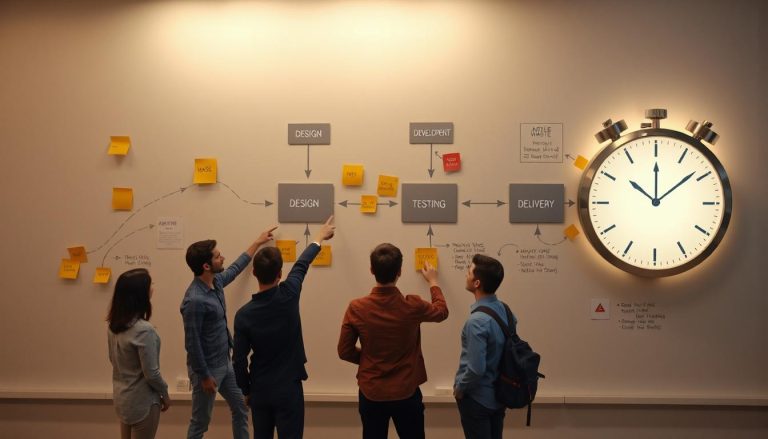
At the heart of every effective Agile Innovation Lab beats the pulse of the sprint. Sprints are short, focused bursts of creative energy typically lasting from a week to a month where teams rally to tackle a precisely defined challenge. These gather people around a specific experiment, prototype, or market test with a single goal: to learn as much as possible, as quickly as possible, without overcommitting resources.
Here’s how a typical sprint rhythm might look:
- Kickoff and Alignment: The team collectively clarifies the experiment’s objective, hypotheses, measures of success, and known constraints.
- Ideation and Framing: Through brainstorming and problem-framing sessions, the team narrows down which ideas to prototype prioritizing those with the biggest potential impact or learning value.
- Rapid Prototyping: Instead of multi-month technical investments, teams build quick-and-dirty versions of product features, business models, or service concepts. Low-fidelity mockups, clickable wireframes, or even role-play scenarios are par for the course.
- Customer Feedback: During the sprint, immediate input from real users or stakeholders is solicited. This feedback loop is what gives Agile its speed it exposes assumptions, highlights what resonates, and uncovers flaws before too much is invested.
- Demo and Debrief: At sprint’s end, the team presents findings informally to sponsors, peers, or potential users. They candidly share what worked and where things fell flat.
- Iterate or Pivot: Based on what they’ve learned, the team decides: double down, tweak, or toss out the idea entirely.
This cycle short, action-oriented, and adaptable ensures that labs don’t get bogged down by analysis paralysis. It liberates teams to try unconventional things, learn, and move on, fueling a steady stream of innovation.
Testing Big Ideas: De-Risking with Data and Empathy
Innovation means betting on uncertain ideas, but betting smart. That’s why Agile labs don’t just toss spaghetti against the wall; they rigorously test every major hypothesis. Instead of aiming for perfection in isolation, teams use rapid experiments to suss out what sticks and what fumbles.
In practice, this might mean building a landing page to see if potential customers sign up for a non-existent feature or conducting time-boxed user interviews with clickable mockups. The golden rule? Gather real-world data before escalating investments.
Key strategies for testing within Agile innovation labs include:
- Minimum Viable Products (MVPs): Strip an idea down to its most basic, testable form. If users ignore it, or if it doesn’t deliver value, there’s little loss but enormous learning.
- Wizard-of-Oz Pilots: Sometimes, digital products are faked behind the scenes to assess real demand before full build-out a trick that’s saved countless teams from expensive mistakes.
- Pretotypes: Earlier than prototypes, these are ultra-basic simulations (sketches, roleplay, digital fakes) that validate if a problem is even worth solving.
- A/B and Multivariate Testing: Multiple versions of a feature or solution are put into the wild to see which ones connect with users.
- User Diaries and Shadowing: Sometimes, observing genuine user behavior or self-reported experiences unearths “unknown unknowns,” challenging the team’s assumptions.
By treating every outlandish idea as a scientific hypothesis, Agile labs radically reduce the risk of bold bets. Failures become learning tools, not organizational liabilities, changing the conversation about risk and reward.
Scaling Winners: From Experiment to Impact
While many ideas crash and burn in the glare of customer reality, a select few show sparks of promise. Agile Innovation Labs aren’t content with just finding the next big thing they’re obsessed with scaling it smartly. The trick lies in identifying early signals of traction and quickly transitioning from test mode to broader rollout, but without losing the spirit of experimentation.
Here’s the playbook for scaling success, Agile-style:
- Stage Gates: At each phase prototype, pilot, launch ideas are evaluated with predetermined criteria to ensure only the most viable concepts eat up further resources.
- Incremental Investment: Instead of betting the farm, allocate more time, talent, and money only as ideas validate themselves at each milestone.
- Iterative Scaling: Roll out to broader user groups one step at a time, watching carefully for dips in quality, user satisfaction, or unforeseen snags.
- Integration with Core Business: Winning innovations shouldn’t exist on an island. Agile labs work closely with business units to bake successful experiments into the company’s main offerings, leveraging operational muscle for real impact.
- Continued Feedback Loops: Just because an idea is scaling doesn’t mean learning stops. Labs keep listening, adjusting, and improving as new users and markets react.
One often-overlooked element is storytelling. Teams that amplify their small victories, sharing the narrative both inside and outside the organization, create momentum. The story of a quirky idea’s journey from whiteboard sketch to real-world product inspires the next wave of innovation.
Measuring Success: Metrics that Matter
It’s tempting to think innovation is all about wild creativity and gut feeling. However, Agile labs know that clear, actionable metrics are the north star guiding their efforts. But here’s the rub: standard business KPIs (like quarterly revenue) rarely capture the true value of innovation especially in the early, uncertain stages.
Instead, top labs track a unique blend of quantitative and qualitative indicators:
- Learning Velocity: How quickly are teams validating or invalidating core assumptions?
- Customer Engagement: Are real users interacting with prototypes, and are their behaviors changing as a result?
- Experiment Throughput: How many distinct tests or sprints are completed over a time period, and what percent led to actionable insights?
- Teams’ Morale and Engagement: Do lab members feel safe to take risks and motivated to iterate, or is burnout setting in?
- Transition Rate: What portion of tested concepts successfully move into larger pilots, and eventually to market or integration?
- Unexpected Wins (Serendipity Index): How often does the lab’s openness result in happy accidents or surprising discoveries?
By focusing on learning rather than just output, Agile Innovation Labs avoid the trap of “vanity metrics.” Each measure isn’t an endpoint but a feedback signal pointing toward continuous improvement and more impactful experiments.
Cultivating a Culture of Agile Experimentation
Speed and creativity can’t be legislated top-down; they must be grown from the ground up. Agile Innovation Labs know their greatest asset is not any single tool or methodology, but a culture that celebrates trial, error, and relentless curiosity. Transforming how a company thinks about risk and experimentation is often tougher than writing code or building prototypes!
Practical ways to embed these values include:
- Ritualizing Reflection: Regularly scheduled retrospectives (not just after failures, but also small wins) shape an environment where learning is prioritized over blame.
- Democratizing Innovation: Open calls for ideas, company-wide brainstorms, and “innovation days” give everyone a stake not just lab insiders or executives.
- Visible Leadership Support: When senior leaders roll up their sleeves, participate in sprints, or publicly share their own learning journeys, it signals that experimentation isn’t just permitted, it’s encouraged.
- Failure Celebrations: Ceremonies or internal showcases for “most instructive flops” reinforce that brave attempts, not just safe wins, move the company forward.
Over time, these habits take root, turning labs from isolated islands of creativity into engines that regularly power innovation across the whole organization. The result isn’t just a string of new products, but a company that continuously reinvents itself.
The Road Ahead: The Lasting Value of Agile Innovation Labs
As technology continues to accelerate, the companies that thrive will be those that can learn and unlearn at lightning speed. Agile Innovation Labs are not a fad; they’re a response to the fundamental uncertainty every business faces in the age of disruption. By combining the discipline of Agile with the spirit of bold invention, these labs turn big, risky ideas into practical, value-creating realities whether that’s a new digital product, a revolutionary business model, or a simple process tweak that saves millions.
Ultimately, success in innovation isn’t about who has the biggest budget, the fanciest lab, or the slickest gadgets. It’s about adaptability, empathy, and the courage to try, fail, and try again. Agile Innovation Labs, with their unique blend of speed, collaboration, and risk-taking, are lighting the way for teams daring to dream and smart enough to deliver.
For organizations willing to cultivate the right environment to empower talent, run disciplined experiments, and celebrate real learning the future opens wide with possibility. The next world-changing idea is there, waiting to be discovered, tested, and scaled in the beating heart of an Agile Innovation Lab.