Agile in Non-Tech Startups: Scaling Smart
Understanding Agile Beyond Software: A Fresh Perspective
When people hear “Agile,” their minds immediately leap to software development or perhaps tech giants working on complex code. But here’s the thing Agile is far more versatile than its techy reputation suggests. At its core, Agile is about adopting a nimble, iterative approach that welcomes change, accelerates delivery, and keeps teams in sync. If you strip away the jargon and look past the coding context, you’ll find a treasure trove of principles that offer just as much value in non-tech businesses maybe even more, given their unique challenges.
Picture a brand-new bakery, a not-for-profit community initiative, or an innovative retail startup. Even without dealing in lines of code, they’re still grappling with unpredictability, shifting customer expectations, and the urgent need to make every resource count. That’s where Agile steps in, acting as a guide to smart scaling and growth. Let’s unravel how non-tech startups can harness Scrum sprints, Kanban boards, and Agile thinking to scale without letting operations turn into a free-for-all.
The Building Blocks: Agile Principles for Everyday Teams
Before diving into sticky notes and progress charts, it’s essential to grasp what makes Agile tick. No two businesses are identical, but Agile is surprisingly adaptable. Its core principles like empowering teams, embracing adaptability, and delivering value in small, controlled bursts aren’t exclusive to coders. Here are the cornerstones non-tech startups should focus on:
- Continuous Feedback: Regular check-ins for honest, constructive critique foster transparency and growth.
- Iterative Delivery: Instead of overwhelming launches, deliver in digestible chunks whether that’s a marketing campaign rollout or a product sampling event.
- Team Autonomy: Trusting small teams with decision-making nurtures accountability, motivation, and efficiency.
- Responding to Change: Pivot as needed, adjusting roadmaps quickly based on feedback, competition, or internal learnings.
In essence, Agile urges startups to stop chasing perfection and instead learn through doing, even when that means a few stumbles along the way. These guiding tenets pave the way for tools like Scrum and Kanban not as buzzwords, but as functional blueprints for growth.
Kanban Boards: Visualizing Workflows to Eliminate Chaos
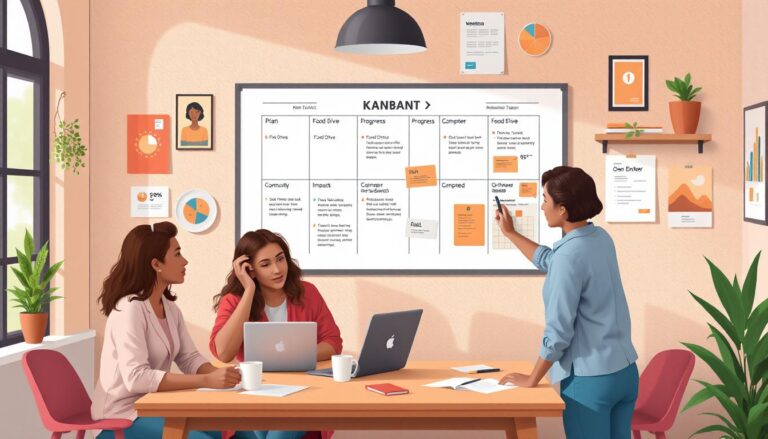
Non-tech startup teams often juggle a mind-boggling array of tasks supplier negotiations before breakfast, event planning by lunch, and social media troubleshooting in the afternoon. Without a clear visual on who’s handling what, balls inevitably get dropped. That’s where the Kanban board comes in, acting like a GPS for daily operations.
A Kanban board isn’t about fancy tech; sometimes, a whiteboard and Post-its work wonders. Here’s the basic structure:
- To Do: Upcoming tasks, big and small
- In Progress: What’s currently being tackled
- Done: A satisfying log of completed work
Want to move beyond the basics? Try adding columns like “Awaiting Feedback” or “Blocked” for extra context. Slowly, patterns emerge. Are too many tasks stuck before completion? Does someone always have a pile on their plate? Kanban makes bottlenecks glaringly obvious like how a leaky faucet wastes water drop by drop giving you the clarity to plug those leaks fast.
For example, a boutique fashion startup used Kanban to track their design and fulfillment pipeline. Suddenly, issues like silent delays in fabric shipments or overlapping roles were no longer lurking in the background. Within weeks, their workflow became smoother, and morale lifted follow-through was visible and celebrated.
Scrum Sprints: Momentum Over Marathon Mentality
While Kanban shines a spotlight on ongoing work, Scrum takes teams into deliberate, focused bursts: sprints. Imagine slicing your grand business ambitions into hearty, two-week challenges with crystal-clear targets. It’s about momentum think “move the needle” rather than “boil the ocean.”
Here’s how sprints can transform operations:
- Plan & Prioritize: Before a sprint, the team agrees on what’s achievable (and meaningful). For a food delivery startup, that might mean rolling out a new menu item or speeding up the ordering process.
- Dedicated Execution: For the next 1-4 weeks, everyone is laser-focused on the sprint goals. Distractions get parked unless they’re mission-critical.
- Review & Reflect: When the sprint ends, the team checks results, celebrates wins, and analyzes fumbles together. The feedback loop drives improvement not blame.
Non-tech businesses often fear “wasted efforts” and big, irreversible bets. Sprints shrink the risk. For example, a wellness startup piloted new classes as sprint experiments. Within a month, winners emerged via customer feedback and revenue tracking, saving the team months they could’ve wasted on the wrong offering.
What stands out with sprints is the energizing pace urgency without burnout. Breaking work into bite-sized adventures not only lightens the load but also helps teams adapt quickly. Goals shift? Customer tastes change? Sprints ensure you’re never too locked-in to course-correct.
Scaling Operations the Agile Way: Step-by-Step Guidance
No one launches a business expecting growth to happen in neat, predictable increments. The reality is more like juggling: as new clients, tasks, or markets pile on, processes that worked at five team members implode at 20. Here’s how to use Agile to scale smart not just fast.
- Document the Essentials: Start simple. Use Kanban to nail down current workflows. What’s working? Where do things fall apart?
- Empower Micro-Teams: As operations grow, delegate ownership using Agile squads. A marketing “pod,” for example, can handle all campaign experiments using their sprint system. Each pod adapts as needed but checks in regularly with the wider team.
- Decentralize Decision-Making: Agile places trust (and responsibility) at the ground level. No more bottlenecked approvals. Allow squads to make quick calls within their domain.
- Rinse and Repeat: Don’t fret if every experiment isn’t a hit. Agile hinges on retrospectives: the regular habit of stepping back, asking “What did we learn?” and fine-tuning as you go.
- Invest in Tooling (But Don’t Overdo It): Digital Kanban boards (like Trello or Asana) can help as teams spread out. But, especially for non-tech startups, don’t drown in fancy digital tools. The process matters more than the platform.
An online learning startup adopted this approach, dividing their fast-expanding content creation team into small, semi-autonomous units. Each group tackled a different area curriculum design, video production, or learner support working in sprints. As enrollment doubled, chaos didn’t follow; small teams stayed coordinated, tracked their hurdles, and learned in short cycles.
Building a Culture for Agile Success: Communication, Trust, and Resilience
No system no matter how elegant survives long without a culture to support it. Agile isn’t a magic fix; it’s a collection of values that must be lived. For non-tech startups, three ingredients are especially important:
- Transparent Communication: Make it safe to say, “I’m stuck,” early and often. Use daily or weekly gatherings (standups) to surface progress and bumps in the road. The earlier issues are raised, the faster they are resolved.
- Psychological Safety: All the planning in the world fails if team members feel they’ll be blamed for honest mistakes. Agile organizations promote learning over finger-pointing.
- Resilience over Rigidity: Change is constant. Teams should feel empowered to tweak Agile processes as needed, rather than clinging blindly to rules. Is a retrospective gathering getting stale? Change it up. Are standups running too long? Streamline them.
Consider the story of a small consulting startup where the founder routinely checked in with the team for feedback on workflows. Instead of sticking to the same retro format every week, they hosted walking meetings one month, coffee chats the next. The result? People spoke up more, offered bolder ideas and felt genuinely invested in adaptations. That’s agility in action, beyond any board or tool.
Adapting to Market Shifts: Navigating Uncertainty Without Panic
Markets pivot overnight think of how suddenly supply chains were disrupted during a global pandemic or how a viral trend can spike product demand unexpectedly. For non-tech startups, the ability to respond decisively is often the difference between staying afloat and capsizing.
Agile practices give you nimble “antennas” for real-time feedback and flexible responses:
- Rapid Prototyping: Test ideas without heavy investment. Lean into small pilots and learn from quick launches.
- Continuous Listening: Keep a finger on the pulse through regular customer interviews, feedback loops, and social listening. Incorporate learnings into each new sprint.
- Scenario Planning: Use sprint reviews to discuss “what if” scenarios, prepping the team for various possible market futures.
- Empowered Teams for Swift Action: Decentralize response capability so sudden shocks (like a supply issue) can be handled fast, without every decision escalating to the top.
Take, for instance, a small-scale organic grocer. When faced with a rapid shift in food trends and fluctuating supplier reliability, their Agile workflow enabled prompt supplier swaps and new product trials. Not only did they maintain quality, but their reputation for adaptation actually drew more customers during tumultuous periods.
It’s not about “jumping on every trend” but having the muscle memory to shift gears and the calm to do it without panic.
Bringing It All Together: Practical Tips for Non-Tech Startup Leaders
Scaling a business in today’s landscape isn’t about out-muscling the competition it’s about out-learning and out-adapting them. Agile thinking, anchored by tools like Kanban and Scrum, gives even rookie entrepreneurs a fighting chance to grow with clarity and purpose.
To set your non-tech startup on a path toward sustainable scaling:
- Start small a physical Kanban board or a simple two-week sprint can spark outsized improvements
- Celebrate incremental wins; short feedback loops fend off “burnout by big reveal” and keep teams motivated
- Invite broad participation: Agile isn’t something you do to your team, it’s something you build with them
- Stay humble: Expect failures, embrace the lessons, tweak your process, and repeat
- Never make Agile a “rulebook” treat the principle of flexible adaptation as your north star
At the end of the day, Agile in non-tech startups is less about copying Silicon Valley’s playbook and more about finding your own rhythm. It’s the difference between rigidly following dance steps and learning to improvise responding to the music and the moment. It requires courage, lots of curiosity, and a willingness to be uncomfortable on the journey to growth.
With Agile, the chaos of scaling becomes a controlled experiment, where the messiness of real-life business is acknowledged, valued, and used as fuel to get better sprint by sprint, board by board, and day by day.